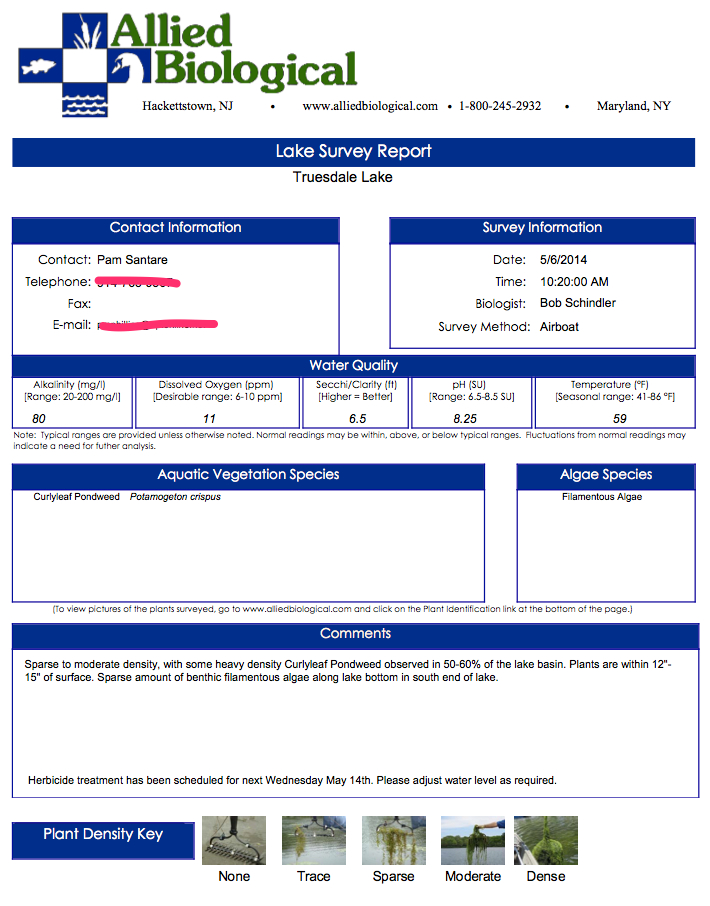
Allied came for rescheduled treatment this morning. Survey report attached. Excerpt below:
Moderate to heavy density Curlyleaf Pondweed in 60-70% of the lake basin. Plants at or within 1′ of the surface. A few scattered stems of Leafy Pondweed observed, as well as trace amounts of Elodea in the south end. Sparse filamentous algae occupies the shallowest cove areas. Water clarity is good. Recommend that the sediment basin adjacent to boat launch be excavated again.
Herbicide Sonar AS applied for weed control. Treatment notices were posted in public access areas.
May 19, 2014
by rob Comments Off on Treatment Rescheduled for May 20th
Last week’s treatment was postponed due to heavy rain forecast. Since we need to retain the water for a set time after treatment, it was postponed to make it more effective and longer lasting. New treatment day is Tuesday, May 20th, 2014.
May 8, 2014
by rob Comments Off on May 14th Lake Treatment
Allied is scheduled to treat the lake for Curly Pondweed next Wednesday, May 14, 2014. The main summer board will go in and Ken will build up the dam to hold the treatment in for 14 days.
Since Allied will be applying an herbicide, posted signs will indicate no swimming for 24 hours and no irrigation for 14 days.
Information about the 2014 treatment program for the lake is available here.
May 7, 2014
by rob Comments Off on First Allied Plant Survey of 2014
Allied Biological visited the lake yesterday to perform a plant and algae survey. Results are attached below. Click to view larger. Let us know if you have questions or comments.
February 26, 2014
by rob Comments Off on A Meeting for Southern NY Lake Associations on Lake Management Options
The Three Lakes Council is sponsoring a meeting at the South Salem Firehouse (1190 Route 35, South Salem, NY) for southern New York lake associations on Thursday, March 27th, 2014 from 6:30 – 8:30pm.
Allied Biological is organizing the speakers including representatives from Vertex Aeration Systems, BioSafe Systems, and Glenn Sullivan, President of Allied Biological. The topic is Lake Management.
Space is limited as this invitation has gone out to lake associations in the southern New York area. Please limit your attendance to four people per association.
RSVP by March 20th, 908-850-0303 or glenn@alliedbiological.com.
Light refreshments will be served.
February 18, 2014
by rob Comments Off on Letter of Notification
I will “overseed” my lawn rather than spread fertilizer or pesticides. I’ll tell my lawn service – or myself – to cut my grass high and leave the clippings on the lawn. If I think fertilizer is needed, I’ll use phosphate-free fertilizer since it’s the law. I will also tell my lawn care company that it is illegal in Westchester County to use phosphate based fertilizer unless extensive testing has been done on the soil – and even then only on a limited basis and never within 20 feet of the lake.
This year I’ll make sure no oil or gas from my mower or car spills on the ground or into the lake.
If I take coolers, sand toys, or other beach or boat items to another waterbody, I’ll make sure that they are free of weeds and shells before bringing them back here so I don’t transport invasive plants and animals.
If I haven’t done so already, this is the year I’ll take a safe boatingcourse.
I’ll start or use a compost pile (away from the lake shore, wet areas, or streams).
We recently came across it and are re-posting it for the benefit of residents new and old.
Multiple watersheds shown including specific watersheds for the seven different lakes in town.
On May 7th, 2009 at 7:30pm the firm EcoLogic, LLC of Cazenovia, NY will present the townwide lake study to the Town Board. The Town Board meeting for that evening is scheduled for 7:30PM at the Increase Miller School in Goldens Bridge. See the Town of Lewisboro website for more details and agenda.
History:
In August 2007, EcoLogic, LLC entered into an agreement with the Town of Lewisboro via the Lewisboro Lakes Committee to develop a planning document outlining management of the lakes and watershed areas within the Town.
The zip file containing the MS Access database used for producing the charts, graphs, and analysis is available here. (2.5Mb est zipped size)
Four specific objectives were cited:
Create a central repository of natural resource data, statistics, and testing data for each of the lakes in the Town;
Summarize each lake’s water quality and environmental concerns;
Recommend the most logical, environmentally sound, and cost-effective sequence of projects to improve and maintain water quality throughout the Town;
Synthesize and collate all the studies on each of the lakes.
Additional data gathering and evaluation tasks were included to meet the overall objectives. This document – Town-Wide Comprehensive Lakes Management Plan – summarizes the water quality and aquatic habitat conditions of seven lakes in the Town of Lewisboro, and recommends measures for their protection and restoration.
Report Organization
The Town-wide Lakes Management Plan is organized in three sections. The first is composed of this introduction, a summary of the environmental settings of the lakes, followed by “Fact Sheets” for each lake. These fact sheets may be used as reference material for the lake associations. The second section discusses the water quality issues on a Town wide basis, identifies the pollutant(s) of concern and their source(s), and identifies reductions needed to meet restoration goals. The third and final section is a synthesis of management options and sets forth recommendations and priority actions for the Town of Lewisboro.
I have been noticing large amounts of road salt in certain areas around the lake, and it made me wonder what sort of effects the salt can have on lake ecology. I started Googling, and discovered that road salt run-off can actually cause blue-green algae problems like the one we experienced last summer! Here are links to a couple of articles I found, but there are many more if you Google “road salt, algae“. -Ami N.
Here are some links to online articles that clearly state the problem with adding sodium chloride (NaCl, or ‘road salt’) to our water column. In short, when the water chemistry is changed, it can kill off green algae and phytoplanktons — which do not tolerate higher salt concentrations well — and leaves an opportunity for blue-green algae to flourish. This type of algae is less desirable, has a foul odor, and some species can be irritating to the skin or mildly toxic. Not something we want in our lake.
There are alternatives (check the New York Water article, linked below), or we can simply do without the rock salt treatment around the lake watershed.
Article excerpt: “The major threat to the lake from salt is a change in how the lower levels of the food web work. The rising sodium levels are shifting the lake’s chemical composition from being dominated by calcium carbonate to sodium chloride. That results in a shift in the phytoplankton population from one dominated by diatom algae to one dominated by blue-green algae.
Blue-green algae is much less nutritious than diatom for the rest of the food web, and some blue-green algae species are notorious for toxic blooms”
“Autotrophs, or primary producers that create their own food through chemo- or photosynthesis, such as algae and terrestrial plants are in particular danger of road salt. The presence of increased sodium chloride in an aquatic environment brings about an opportunity for invasive cyanobacteria to enter and dominate the inhabiting species. The cyanobacteria in question here are capable of withstanding the brackish conditions and they flourish accordingly, out-competing the other algae and smothering other organisms within the aquatic ecosystem.”
“Zooplankton…those are the tiny invertebrates that propel themselves around the water column, feeding on algae. If salt kills zooplankton, that’s not just going to mean more green scum on the water, it could also mean that larger predators, like the many species of fish that feed on zooplankton, go hungry.”
“Chronic salt concentrations can damage algae that are food sources for insects that local fish eat; in high concentrations, it can kill amphibians and plants and leach into drinking wells.”
January 17, 2014
by rob Comments Off on Lake Watershed Information
The lake associations commissioned a report on Truesdale Lake in 2001 that was done by Land-Tech Consulting. It has been over 13 years since the report publication and many new residents probably have never seen it.
I have excerpted a map of our lake’s watershed below as well as description of the watershed. The entire report is available here:Â http://truesdalelake.com/downloads/?did=25
The blue line in the map below represents the extent of our 2000+ acre watershed.
Truesdale Lake Watershed (blue line)
A watershed is a drainage area in which all land and water areas drain or flow toward a central collector, such as the lake. Precipitation falling on the watershed that does not infiltrate into the ground will flow over land to the central collector. The size of the contributing watershed largely determines the amount of water that enters the central collector, in this case, the lake.
This lake lies within the Waccabuc River Drainage Basin, which is a sub-basin of the Croton Regional Basin and the Hudson Major Basin. The portion of this watershed contributing surface runoff to the lake is large (2,380± acres, 963 ha), relative to the size of the lake (83 acres, 33.6 ha) (Figure 1). The majority of this watershed is located to the east of the lake and contains the Pumping Station Swamp. The size of the watershed creates a watershed to lake ratio of 28.7:1. The amount of rainfall draining to the lake was calculated using a runoff value of approximately 55 percent of precipitation (CT DEP 1982), an annual precipitation value of 47.5 inches per year (Soil Survey of Putnam and Westchester Counties, New York, 1994), and 68.6 cm (27 inches) per year of surface lake evaporation. Therefore, the net amount of rainfall that drains to the lake is large, (1.6 billion gallons) annually or an average daily flow of 4 million gallons per day. Thus, on an annual basis, the lake, with a volume of approximately 99,150,000 gallons, shows a moderate turnover rate (hydraulic residence time) of 16.2 times per year or every 22 days.
However, since the perennial watercourse is in the northeast portion of the lake and the discharge is at the northern tip of the lake, it is reasonable to assume that much of the water entering the lake from the perennial watercourse exits the system with little mixing of water in the southern lake basin. Therefore, the actual hydraulic residence time in the southern portion of the lake is expected to be longer than that stated above.
The report has additional information about biology, lake treatment, inflows, and management recommendations. Most of the information is still relevant today.